

EU Adds Iran’s Revolutionary Guards to Terrorist List
By Ian Aikman and Ben Hatton
The European Union has added Iran’s Islamic Revolutionary Guard Corps (IRGC) to its terrorist list in response to Tehran’s deadly crackdown on protesters in recent weeks.
“Repression cannot go unanswered,” the bloc’s top diplomat Kaja Kallas said, adding the move would put the IRGC – a major military, economic and political force in Iran – on the same level as jihadists like al-Qaeda and the Islamic State group.
Iran’s Foreign Minister, Abbas Araghchi, said the EU decision was a “stunt” and a “major strategic mistake”.
Human rights groups estimate thousands of protesters were killed by security forces, including the IRGC, during weeks of unrest in December and January.
Speaking in Brussels on Thursday, French Foreign Minister Jean-Noel Barrot described it as “the most violent repression in Iran’s modern history” and said there could be “no impunity for the crimes committed”.
France had previously been seen as hesitant to add the IRGC to the EU’s terror list over fears this could put an end to all diplomatic ties with Iran.
But it changed course on Wednesday, coming out strongly behind a push to blacklist the group, which was led by Italy.
“Any regime that kills thousands of its own people is working toward its own demise,” Kallas said in a brief statement on social media.
She said she expected diplomatic channels to remain open with Iran, even after adding the IRGC to its list of groups involved in acts of terrorism.
The EU also placed new sanctions on six entities and 15 individuals in Iran, including Interior Minister Eskandar Momeni, Prosecutor General Mohammad Movahedi Azad and Iman Afshari, a presiding judge.
“They were all involved in the violent repression of peaceful protests and the arbitrary arrest of political activists and human rights defenders,” the bloc said in a statement.
Organisations on the EU’s terrorist list are subject to sanctions including travel bans and asset freezes, with the aim of removing their support networks.
Iran’s most powerful armed force, the IRGC was set up shortly after the 1979 revolution to defend the country’s Islamic system. It is estimated to have about 190,000 active personnel, with capabilities across land, air and sea, as well as overseeing Iran’s strategic weapons.
It exerts influence overseas by providing money, weapons, technology and advice to allied governments and armed groups, and also controls the paramilitary Basij Resistance Force inside Iran, which has hundreds of thousands of members and has been used to suppress dissent.
Australia, Canada and the US have already classified the IRGC as a terror group but it has not been proscribed in the UK.
On Wednesday, UK Deputy Prime Minister David Lammy condemned Iran’s “brutal oppression of peaceful protesters” but said it was long-standing government policy “not to comment on whether a specific organisation is being considered for proscription”.
The EU’s announcement comes after US President Donald Trump said earlier this week that a “massive Armada” was moving quickly towards Iran “with great power, enthusiasm, and purpose”.
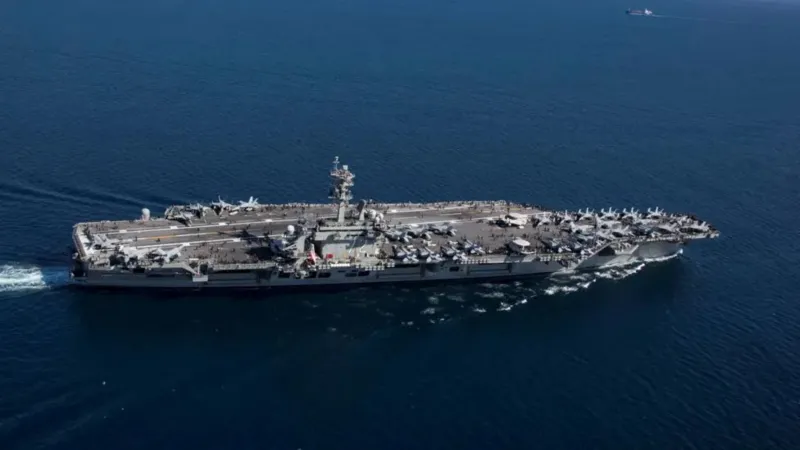
Trump said the fleet was headed by the USS Abraham Lincoln (file image)
Trump warned that “time was running out” for Iran to negotiate a deal on its nuclear programme and urged Tehran to “come to the table”.
On Thursday, the US president said he hoped to avoid military action against Iran by having further talks on a possible nuclear deal.
“I built [up] the military in my first term, and now we have a group headed out to a place called Iran, and hopefully we won’t have to use it,” Trump told reporters at the premiere of a documentary about his wife Melania.
Asked if he would have talks with Iran, Trump added: “I have had and I am planning on it. Yes, we have a lot of very big, very powerful ships sailing to Iran right now, and it would be great if we didn’t have to use them.”
The Iranian foreign minister said the country’s armed forces were ready “with their fingers on the trigger” to “immediately and powerfully respond” to any aggression.
Araghchi said that rather than working to avert “all-out war in our region” Europe was “busy fanning the flames”.
Trump’s latest warning follows his promise that Washington would intervene to help those involved in the deadly crackdown on protesters earlier this month.
An internet blackout imposed by Iran’s authorities has made assessing the scale of the government’s violence against protesters difficult.
The US-based Human Rights Activists News Agency said it had confirmed the killing of more than 6,301 people, including 5,925 protesters, while another group, the Norway-based Iran Human Rights, said the final toll could exceed 25,000.
Iranian authorities have said more than 3,100 people were killed, but that the majority were security personnel or bystanders attacked by “rioters”.
Most international news organisations, including the BBC, are unable to report from inside Iran but videos showing security forces firing live ammunition at crowds have been verified by the BBC.
Original source: https://www.bbc.com/news/articles/c20gypw8enjo


